Pre-Shipment Inspection Report: What It Covers and How It Works
Learn what a pre-shipment inspection report contains, how to prepare a PSI template, interpret results, and act on findings before goods ship.

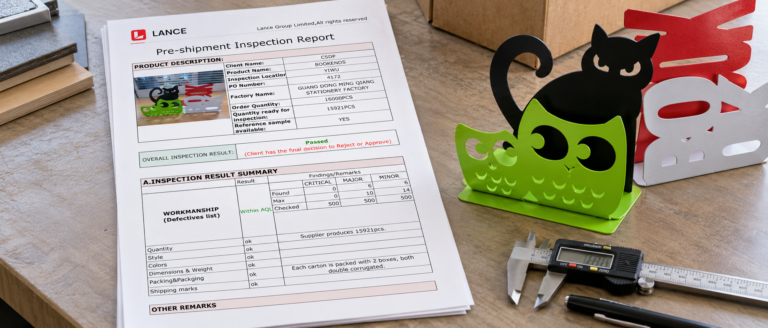
A pre-shipment inspection (PSI) report is the formal written record of a quality check carried out at the supplier’s factory once production is at least 80% complete and goods are packed for export. It records what was inspected, which sampling method was used, every defect found and its severity, and a clear pass or fail outcome. Importers use it to decide whether to release the shipment, require rework, or renegotiate terms before the goods leave the factory and risk transfers to the buyer.
This article explains what a PSI report contains, section by section. It also shows how to prepare the template that drives the inspection, how to read and act on the results, how the PSI report compares with other quality documents, and what to consider when arranging inspections for goods sourced from China and Yiwu.
What a Pre-Shipment Inspection Report Is
The PSI report is the auditable document that proves what was checked, what was found, and what decision was reached. The inspection itself is a physical activity: an inspector visits the factory, selects a sample, and works through a defined checklist. The report captures every finding from that visit in a structured, verifiable format.
This distinction matters because the report is what travels. The importer reviewing the shipment from overseas never sees the factory floor, so the report is their evidence. Freight forwarders may require it to confirm cargo readiness. Banks issuing or receiving letters of credit may request it as a presentation document, to verify that goods match the stated order before releasing payment. Customs authorities in some markets require an independent PSI report before clearing goods for import. In all these cases, the report, not the inspection itself, is what provides protection.

Professional third-party inspection agencies use a consistent template for their reports, so findings can be compared across orders, suppliers, and product categories. With this standardization, a report for an order placed six months ago can be placed side by side with one from today, and any quality drift is immediately visible. The report also carries weight in a dispute because the format is recognized, the methodology is documented, and findings are expressed in measurable terms rather than subjective impressions.
A PSI report is more valuable than a supplier’s own declaration because of its independence and timing. The check happens before title and risk transfer to the buyer, while the supplier still has the goods and can still correct problems. A verifiable record at that moment protects the importer’s interests in ways that a post-arrival complaint cannot, because that complaint is filed after shipping costs and import duties have already been spent.
A verifiable record at the moment before risk transfers protects the importer's interests in ways that a post-arrival complaint, filed after shipping costs and import duties have already been spent, cannot.
Pre-Shipment Inspection Report: What It Covers and How It Works
What a PSI Report Contains: Section by Section
A PSI report is a structured document in which each section serves a different purpose. If you understand what each section should tell you, and what to look for when reviewing it, the report drives real decisions instead of sitting in a folder. Professional third-party agencies follow a consistent template across all these sections, which allows buyers to compare results across orders, suppliers, and product categories.
Order and Inspection Details
The opening section establishes the administrative record: client name, supplier name and address, product description, purchase order number, inspection date and location, and the name and accreditation of the inspector or certifying body. These fields may look routine, but they make the document auditable. A bank or customs authority that checks the report against shipping documents needs to confirm that the inspection covers exactly the order in question.
This section also notes any access restrictions, unusual factory conditions, or deviations from the agreed scope. For example, certain products may be stored separately and unavailable for sampling. These caveats matter because they define the limits of what the report can and cannot confirm.
Sampling Method and Quantity Checked
This section states the sampling standard applied, typically AQL ISO 2859-1, the inspection level used (General Level II is standard for most consumer goods), and the sample size drawn from the quantity ready for inspection. It records the acceptable quality limits agreed for critical, major, and minor defects. It also shows the actual number of defects found in each category, so the pass/fail calculation is transparent and can be independently verified.
Inspectors sample instead of checking every unit because a properly drawn statistical sample gives reliable conclusions about the full batch at a fraction of the time and cost of 100% inspection. The ISO 2859-1 standard defines sample sizes that are statistically representative. For example, for a batch of 281–500 units at General Inspection Level II, a sample of 50 units is drawn. The report should show the batch size, the resulting sample size, and which AQL table was applied, so that anyone reviewing the document can verify that the sampling was done correctly.

Product Checks and Test Results
This is the substantive quality section. It documents every inspection category performed: quantity count against the purchase order, visual and workmanship assessment, dimensional measurements versus the approved specification, functional tests, and safety checks where applicable. Each category should record results numerically, such as a measured dimension alongside the specified tolerance, rather than a simple pass or fail. That way the importer can judge how severe any deviation is, instead of only knowing that one exists.
This section also records the on-site tests carried out during the inspection, together with the equipment or standard used. Examples are barcode scanning, drop tests, carton compression tests, electrical power-on tests, button and switch operation, and seam pull strength. For each test, the report states that it was performed, what acceptance criterion was applied, and whether the result met that criterion.
This section does not cover chemical composition, electromagnetic compatibility (EMC), tensile strength, or other properties that require laboratory equipment, because these cannot be assessed on-site. Separate samples must be sent to an accredited laboratory in advance, and the results appear in a separate lab report. The PSI report should note when lab tests were expected and whether the results were available at the time of inspection, but it cannot substitute for them.
Defect List and Classification
Every defect found during the inspection is listed individually, with a written description, a photo reference, and a classification as critical, major, or minor. The three classifications have specific meanings:

- Critical defects are safety or legal failures: anything that could injure a user, create legal liability, or make the product non-compliant with regulatory requirements in the destination market.
- Major defects affect function or salability: the product does not work as intended, or a retailer or end customer would reasonably reject it.
- Minor defects are cosmetic deviations unlikely to affect end use, such as a small surface mark or slight color variation that a customer would not normally notice or object to.
The defect list is tabulated by category, so the importer can see at a glance how many defects of each class were found in the sample and compare those counts against the agreed AQL limits. A report that gives only a summary verdict, such as “failed”, without a detailed defect list is essentially unusable, because it tells the importer that something went wrong but not what or where. A complete defect list with descriptions and photos lets the buyer tell the supplier exactly what needs rework. This reduces ambiguity and the back-and-forth that delays resolution.
Packaging, Labelling, and Shipping Marks
This section verifies that inner and outer packaging matches the agreed specification: materials, dimensions, gross weight, and required drop-test or compression-test results. It also checks label content systematically: product name, country of origin, barcodes, regulatory marks (CE, FCC, and similar), and any destination-market compliance requirements that apply to the specific product and market, such as language, batch codes, and expiry dates.
Carton shipping marks are checked against the shipping instruction: purchase order number, destination port, gross and net weight, and case count. This step is sometimes treated as administrative, but errors in shipping marks cause real problems at the port, including customs delays, incorrect routing, and re-labeling costs that could have been avoided entirely. A carton can hold a product that meets all quality standards, but an incorrect destination port on the mark can still hold up the entire shipment.
Photos and Supporting Evidence
A professional PSI report includes an extensive photographic record: images of the production floor, the random sample selection process, product close-ups from multiple angles, defect shots with measurement references where applicable, and photos of packaging and labels. Timestamped photos confirm that the inspection took place on the stated date. They also serve as independent visual evidence that neither the supplier nor the importer can easily dispute.

Photos are particularly valuable when the importer needs to tell the supplier what rework is required, because an image of the specific defect is faster and less ambiguous than a written description alone. Some inspection providers also include video clips for functional tests or complex assemblies. A video of a mechanical component being operated, or of a power-on test being run, can resolve disagreements about whether a defect was real or how it appeared.
Overall Result and Inspector’s Conclusion
The final section states a single outcome (pass, fail, or conditional pass) based on whether defect counts stayed within the agreed AQL limits across all defect categories. A pass means that every category is within limits. A fail means that at least one category exceeded its limit. A conditional pass typically indicates a minor overrun in one category with no critical or major failures, and it leaves the shipment decision to the importer’s judgment.
The conclusion also summarizes the inspector’s observations: any deviations from the approved sample, products or cartons that could not be accessed or tested on the day, and anything that remained unverified at the time of inspection. The inspector’s conclusion is advisory. The final decision to release or hold the shipment rests with the importer, not the inspection agency. The report provides the evidence; the importer makes the call.
PSI Report Template: Key Fields to Prepare Before the Inspection
A PSI template is the document the importer prepares before the inspection and hands to the inspector, and it is how the importer communicates quality requirements. Without it, the inspector applies generic criteria that may not match the product’s specific requirements, and the resulting report is hard to act on. You can think of the template as a pre-shipment inspection report example written in reverse: it defines what good looks like before the inspection takes place, so the report can measure against those standards objectively.
Fields left blank in the template will either be skipped or filled with generic defaults. If an inspector has not been told what counts as a major defect for this specific product, the inspector will make a judgment call that may not match what the buyer considers commercially significant. Getting the template right before booking the inspection is one of the most practical things an importer can do to make sure that the report is useful.
Product Specifications and Approved Sample Reference
The template should include or reference all specification documents: technical drawings, material specifications, color standards, and the details and reference number of the approved pre-production sample. The inspector’s primary job is to compare finished goods against that approved sample. Any unresolved discrepancy between the sample and the spec will therefore appear as a reportable defect, even if the buyer and supplier had already informally agreed on a change.
Vague specifications produce inconclusive reports. A spec that says “good quality stitching” gives the inspector no objective basis for a finding. A spec that says “stitch density minimum 8 per centimetre, no visible skipped stitches” produces a measurable, comparable result. The effort spent writing measurable tolerances pays off every time the report is used to resolve a dispute or compare results across batches.

Defect Criteria and AQL Limits
The template should include a defect classification table built specifically for the product, not just a generic description of the three severity levels. For each product category, define what counts as critical, major, and minor for that SKU. For example, a scratched surface might be minor for an industrial component but major for a consumer electronics device sold in premium retail packaging.
Common default AQL thresholds for consumer goods are zero for critical defects, 2.5 for major, and 4.0 for minor. High-value products, or those sold into regulated markets, often tighten the major threshold to 1.0. The agreed limits must appear in the template so that the inspector calculates pass/fail against pre-agreed standards rather than applying their own judgment in the field. If limits are set too loosely, the report can technically pass while still containing a commercially significant number of major defects. In that case the report gives a green light that the importer should not take at face value.
Packaging and Labelling Requirements
State packaging requirements in measurable terms: carton materials, internal and external dimensions, gross weight limits, and required drop-test or compression-test standards with acceptance criteria. It is not enough to specify that the outer carton must pass a drop test. If you specify the drop height, number of drops, and what counts as a pass, the inspector has a test they can perform and record objectively.
Label requirements should list every field the destination market requires: barcode format and verification standard, regulatory symbols (CE, FCC, RoHS, and others relevant to the product and market), required languages, batch or lot codes, and expiry or manufacturing dates where applicable. Provide this as a checklist rather than a narrative description. The inspector can then verify each item systematically and record any missing or incorrect field precisely.
Include shipping mark requirements to catch mislabeled cartons before they reach the port. The template should specify the required format for PO number, destination port, gross and net weight, and case count. The inspector can then check carton marks against the shipping instruction and flag discrepancies before they become a customs problem.
On-Site Tests to Include
The template should identify which tests can realistically be performed at the factory and which need a laboratory, and it should specify the acceptance criterion for each on-site test. On-site tests commonly included in a PSI are:
- Barcode scanning (all codes scan correctly against the product database)
- Button and switch operation (number of actuations without failure)
- Electrical power-on (device powers on and displays correctly)
- Seam or bond pull strength (force required to separate a seam or adhesive joint)
- Assembly completeness (all components present and correctly assembled)
- Drop test or carton compression (packaging integrity under transport simulation conditions)
Tests that require laboratory equipment cannot be captured in the PSI report. Examples are chemical composition (REACH, RoHS), electromagnetic compatibility (EMC), and tensile strength to ASTM standards. Samples for these tests must be sent to an accredited laboratory in advance of the inspection. The template should reference any lab test reports expected alongside the PSI, so the inspector knows to confirm that they are available and to include a reference in the report. Failing to plan lab tests separately is one of the most common gaps in quality documentation for regulated products.
A Note on PSI Report Templates and Examples
Many third-party inspection agencies publish downloadable PSI report templates or completed sample reports that illustrate the expected format and level of detail. It is practical to review a completed pre-shipment inspection report example before commissioning the inspection. It shows exactly what the finished document will contain. It also lets the importer confirm, before the inspection is booked, that the format meets their internal documentation requirements, LC conditions, or retail customer requirements.
A completed PSI report example typically contains: a branded cover page with order details and the overall outcome; an administrative header; an AQL sampling table showing batch size, sample size, and accept/reject thresholds; a category-by-category results grid; a defect log with descriptions and photo references; and a conclusion page with the inspector’s summary. Providers such as QIMA publish sample reports that show what a professionally structured document looks like.

A template obtained from a provider will often need adaptation. Generic checklists cover standard categories such as quantity, workmanship, labeling, and packaging, but they may not capture product-specific criteria, market-specific regulatory marks, or proprietary specifications that matter for a particular order. It is more efficient to use a provider’s template as a starting point and add product-specific fields than to build one from scratch, but the adaptation step is essential rather than optional.
How to Read a PSI Report and What to Do with the Results
Receiving a PSI report and filing it is not the same as using it. The report is valuable only if the importer reviews it promptly and makes a decision before the cargo-ready deadline. If the review is delayed, the window for rework or renegotiation shrinks, and the importer may ultimately have to choose between shipping non-conforming goods and missing the sailing.
Interpreting Pass, Conditional Pass, and Fail Outcomes
Each outcome has a specific meaning:
- Pass means that defect counts in the sample were within the agreed AQL limits across all defect categories: critical, major, and minor. The importer can release the shipment with confidence that the batch meets the pre-agreed quality standard.
- Fail means that one or more categories exceeded their AQL limit. The importer should not release the shipment without taking action, because statistically the batch contains a commercially significant number of non-conforming units.
- Conditional pass means that there was a minor overrun in one category with no critical or major failures. The decision is the importer’s: release with acknowledged risk, or require sorting before shipment.
Reading only the final verdict without checking the defect table is a common mistake. A pass achieved against a loosely set AQL threshold (4.0 for major defects, for example) may still reflect a batch where 3–4% of units have commercially significant defects. Before releasing, check the raw defect counts and compare them against your own commercial tolerance, not just the statistical threshold. Some reports include a percentage defect rate alongside raw counts. This rate is easier to compare across batches of different sizes and is useful for tracking supplier performance over time.
Responding to a Failed Inspection
Four options when a PSI report shows a fail
Require rework and re-inspection
The supplier corrects the defects, a new inspection is arranged, and a new report is issued. Factor re-inspection fees and the additional time into the shipping schedule.
Negotiate a price reduction
If the timeline is critical and the defect level is manageable, accept the goods at a reduced price that reflects rework costs at the destination. The PSI report is your documented basis for negotiation.
Cancel or hold the order
For serious or repeated failures — especially critical defects — withholding payment or cancelling is justified. The report provides the documented grounds.
Approve shipment at buyer's risk
Only appropriate for minor overruns unlikely to affect end-customer experience. The importer explicitly accepts responsibility for any downstream consequences.
- Require rework and re-inspection. The supplier sorts the batch and corrects the defects, and a new inspection is arranged. This generates a new report. Re-inspection fees are charged separately from the original inspection, and you must factor the time required into the shipping schedule.
- Negotiate a price reduction. If the defect level is manageable and the shipment timeline is critical, the importer can accept the goods at a reduced price that reflects the rework cost at the destination. The PSI report provides the documented basis for this negotiation.
- Cancel or hold the order. For serious or repeated failures, particularly those involving critical defects, holding payment or canceling is a justified response. The report provides the documented grounds for doing so.
- Approve shipment at buyer’s risk. This is rare, and it is appropriate only for minor overruns that will not affect end-customer experience. The importer explicitly accepts responsibility for any downstream consequences.
Informal supplier assurances after a failure, such as “we fixed it, trust us”, provide no protection in a dispute. The defect descriptions and photos in the failed report are the primary evidence to share with the supplier when you request rework or compensation. Only a re-inspection after rework that produces a new passing report is a defensible confirmation that the problem was actually resolved.
Using the Report for Supplier Accountability
A single PSI report tells you what was found on one order. A series of reports across multiple orders starts to reveal patterns: which defect types recur, which product categories consistently underperform, and whether quality is improving or drifting. You can see this longitudinal view only if reports follow a consistent format. That is another reason why standardized third-party reports are more useful than ad hoc supplier-issued documents.
A consistent reporting trail also has practical value in financial and legal contexts. Under letter of credit terms, the bank may require the PSI report as a presentation document confirming that goods were inspected before shipment. In a warranty claim or customs dispute, a series of inspection reports covering successive orders is substantially more persuasive than a single document or verbal accounts. You can also share aggregated defect data with the supplier as part of periodic business reviews. This creates a shared improvement baseline and is often more effective at driving quality improvement than reactive complaints after individual failures.
When to Release the Shipment
When a report arrives, follow this sequence: review the defect table and photos, compare the findings against your pre-agreed criteria (not just the report’s pass/fail verdict), and tell the freight forwarder your release or hold decision before the cargo-ready deadline. The earlier you do this review after receiving the report, the more options remain available.
A PSI report does not replace customs documentation. The bill of lading, commercial invoice, packing list, and any required certificates of origin or conformity are separate documents, and they must be in order regardless of the inspection outcome. Some markets, buyers, or LC conditions require the PSI report to accompany the shipping documents. Confirm whether this applies before the inspection is booked, not after, because it affects which inspection body is acceptable and what format the report must take.
PSI vs. Other Quality Inspections: Where the Report Fits
A PSI report is one of several quality documents that importers can commission at different stages of the production and shipping process. Knowing where the PSI fits, and where it does not, helps you avoid gaps in quality documentation. It also supports better decisions about which combination of reports suits an order’s value and risk level.
During Production Inspection (DPI) vs. Pre-Shipment Inspection
A During Production Inspection (DPI), sometimes called DUPRO, is conducted when roughly 30–50% of production is complete. Its report focuses on in-process quality: whether the production line is following the correct process, whether raw materials and components meet specification, and whether the production rate is on track. If the inspector finds a systematic defect at this stage, such as incorrect stitching, a wrong component, or an incorrect color mix, the supplier can correct the process before most of the batch is finished, when the fix is relatively cheap.

A PSI is conducted when 80–100% of production is complete. Its report focuses on finished goods quality and shipment readiness, with AQL-based pass/fail on the complete batch. By definition, a PSI finding reveals a problem after most of the batch is already finished. This makes rework more expensive and more time-consuming than catching the same problem during production.
Using both inspections produces two complementary reports that cover the full production cycle. Using only a PSI, the more common choice for cost reasons, means that problems are found late and the cost and disruption of correction are higher. For first orders with a new supplier or for technically complex products, combining a DPI and a PSI gives meaningfully more coverage than either document alone.
DPI vs. PSI: what each report covers
During Production Inspection (DPI)
- Conducted at 30–50% production completion
- Focuses on in-process quality: materials, components, production process
- Catches systematic defects before the majority of the batch is finished
- Correction at this stage is relatively cheap
- Report covers production line conformance, not finished-goods AQL sampling
Pre-Shipment Inspection (PSI)
- Conducted at 80–100% production completion
- Focuses on finished goods quality and shipment readiness
- AQL-based pass/fail on the complete packed batch
- Problems found here are more expensive and time-consuming to correct
- Report is accepted by banks, customs authorities, and retailers as a shipping document
Container Loading Supervision and Final Random Inspection
Final Random Inspection (FRI) is often used interchangeably with PSI, and in practice the two overlap significantly: both involve AQL-based random sampling of finished, packed goods. The practical distinction is one of emphasis. FRI specifically emphasizes random selection from goods already in the warehouse, while PSI is the broader category that can also include functional tests and documentation review. In most international trade contexts, the terms are treated as equivalent.
A container loading supervision report is an entirely different document. It is generated by an inspector who is present while the goods are physically loaded into the container. It records the container number, condition, and seal, verifies the quantities actually loaded against the packing list, confirms that goods are correctly handled and stowed, and captures the final carton count loaded. This report provides evidence of what actually went into the container. A PSI report, carried out in the warehouse before loading, cannot provide that information.
Some importers need to verify both finished goods quality and actual loaded quantities. This is common for high-value shipments or where discrepancies have occurred in the past. In that case, a PSI report and a loading supervision report serve distinct purposes, and neither can substitute for the other. Some importers commission DPI, PSI, and loading supervision together for high-risk shipments. Knowing what each document covers prevents misunderstandings about what has and has not been independently verified.
Which Inspection Type Generates a Report You Can Act On
The PSI report is the most actionable pre-departure document available to importers. It covers finished goods, uses AQL sampling with a defined pass/fail outcome, and is issued before loading, which leaves time for rework, renegotiation, or a hold decision. It is the last point in the production process where the importer can intervene at acceptable cost.
Incoming inspection reports, generated after goods arrive at the destination, document what is received. By the time such a report exists, however, the importer has already paid shipping costs and import duties and spent the transit time on potentially non-conforming goods. Disputes with overseas suppliers are also harder to resolve once goods have left the factory, and the supplier’s leverage is gone.
For importers ordering from new suppliers or launching new products, the PSI at the factory stage is the last cost-effective point to intervene before ownership and risk transfer to the buyer. Once the container is sealed and loaded, the importer’s options narrow significantly. This makes the PSI report not just a quality tool but a commercial risk management instrument.
When to Commission a PSI and Who Conducts It
The PSI report is only as useful as the timing of the inspection and the independence of whoever conducts it. Getting these two factors right is the most practical decision an importer makes when planning quality control for an order.
Situations That Justify a PSI
A PSI is most clearly justified in the following situations:
- First order with a new supplier. No production track record exists. The report provides baseline evidence of what the supplier can actually deliver at scale, which no amount of pre-order sampling or factory audit can replicate.
- High-value or large-quantity orders. When the cost of defects, returns, or re-shipping significantly exceeds the inspection fee, the economic case for a PSI is straightforward.
- Regulated or safety-critical products. Electronics, children’s items, medical accessories, and similar products create legal liability in the destination market if they fail compliance requirements. A PSI report that includes regulatory mark verification is a documented step in due diligence.
- Amazon FBA and e-commerce sellers. Customer returns, negative reviews, and platform penalties are direct financial consequences of shipping defective goods. Because the cost of an inspection is small compared with the cost of platform penalties or account suspension, a PSI is economically rational even for moderately sized orders.
- Repeat orders from previously approved suppliers. A lighter inspection cadence may be appropriate, but consistent reporting still provides an audit trail and catches supplier drift: a gradual quality decline that is invisible on any single order but evident across a series.
Timing: When to Book the Inspection
The 80% production completion threshold exists for a practical reason: the inspector needs a representative sample of finished, packed goods. If you book too early, a significant portion of the order is unfinished or unpacked and cannot be sampled, so the results will not reflect final production quality. If you book too late, without a confirmed inspection date, you risk pushing past the cargo-ready deadline, particularly if issues are found and rework is required.
Third-Party vs. In-House Inspection
The choice of who conducts the inspection directly affects what the report can be used for:

| Inspector type | Independence | Report weight | Practical constraints |
|---|---|---|---|
| Third-party agency | No commercial relationship with supplier | Accepted by banks, customs, retailers | Fee per man-day; advance booking required |
| Buyer’s in-house inspector | Reports to buyer, not supplier | Credible internally; less weight externally | Only practical if qualified staff are near the factory |
| Supplier self-inspection | None—supplier inspects own goods | Compliance declaration only; not accepted by most banks | Not a substitute for independent QC |
Treat a supplier-issued inspection report as the supplier’s declaration of conformity. It is useful as a reference but not as independent quality assurance. Most importers and LC-issuing banks will not accept it as a substitute for a third-party report. In disputes, returns claims, or regulatory inquiries, the independence of the third-party inspector is what gives the report its evidentiary weight.
Cost Considerations
Third-party PSI fees are typically charged per man-day and vary by country, product complexity, and inspection agency. Multi-day inspections for large or technically complex orders are charged accordingly. Rates differ by region and service scope, so confirm the specific fee structure, and whether subscription or volume pricing is available, directly with the provider.
The relevant comparison is not the inspection fee in isolation but the inspection fee against the cost of a failed shipment: returns logistics, rework at the destination, re-shipping, lost sales during stockout, e-commerce platform penalties, and reputational damage. For orders of meaningful value, this comparison almost always favors the inspection. Re-inspection after a failed PSI incurs additional fees and extends the timeline. Factor both into the production schedule and budget, so that they are not unexpected costs if a failure occurs.
Getting a PSI Report for Goods Sourced from Yiwu and China
For importers sourcing from Chinese factories and Yiwu market suppliers, the PSI report carries additional significance. The buyer is typically overseas and cannot visit the factory personally, so the report is not just a quality tool but the primary independent evidence of what was produced and shipped. It substitutes for the buyer’s own eyes at the factory, at the moment when intervention is still possible.
A sourcing agent or inspection coordinator based in China can arrange and attend the inspection, communicate with the factory in Chinese, resolve access or scheduling issues on the ground, and send the completed report digitally within 24–48 hours of the inspection. This matters in practice. Language barriers and time zone differences mean that an overseas buyer who relies entirely on email to coordinate an inspection at a Chinese factory will often find that critical details are confirmed too late to affect the inspection outcome. These details include production status, sample availability, and access to specific carton batches.

Several practical considerations are specific to sourcing from China:
- Factory location and inspector coverage. China’s manufacturing geography is varied: factories are concentrated in Guangdong, Zhejiang, Jiangsu, Fujian, and other provinces. Most major third-party inspection agencies maintain inspector networks across these regions. Confirm coverage for your specific factory location at the booking stage, not after, particularly for smaller cities or factory clusters outside major hubs.
- Language of the checklist. Translate the defect criteria and inspection checklist into Chinese and share them with the factory before the inspection, so factory staff understand what will be checked and can ensure that the right goods and personnel are accessible on the day. A checklist that arrives in English only can cause avoidable friction and delays on-site.
- Authority to place a hold. If the inspection results in a fail or conditional outcome, the agent or inspector needs clear, pre-authorized instructions. They must know whether they can place a hold on the shipment pending rework, or whether they must first escalate to the overseas buyer. Ambiguity at this point compresses the available response window.
- Escalation of urgent findings. Define in advance how critical findings are communicated: a direct message to the buyer’s decision-maker, not a formal report filed 24 hours later. Time-sensitive findings, such as a product bearing incorrect regulatory marks for the destination market, require immediate escalation, not a report reviewed the following morning.
Inspection coordination is more complex for Yiwu market orders. Yiwu suppliers often produce in smaller batches, sometimes across multiple workshops rather than a single factory. A consolidation agent managing goods from multiple suppliers in a shared warehouse needs to confirm production completion with each supplier separately, and to coordinate inspection access across different locations or stock consignments. To avoid scheduling conflicts that delay either the inspection or the subsequent cargo-ready date, communicate early with both the supplier and the logistics coordinator: before production is finished, not on the day of booking.
If you are sourcing from Yiwu and need support coordinating quality inspections, order follow-up, and shipment preparation, Lance’s sourcing and order management services are designed to handle exactly these coordination tasks on the ground.
Frequently Asked Questions
What is the purpose of a pre-shipment inspection?
A PSI verifies that finished goods meet the buyer’s quality specifications, labeling requirements, and purchase order terms before they leave the factory. Its primary purpose is to identify defects and non-conformances while the goods are still accessible and correctable. This is the last cost-effective point to intervene before ownership and shipping risk transfer to the buyer. See the opening section for a full explanation.
What are the main types of quality inspection in manufacturing?
There are four main types, and together they cover the production lifecycle: Initial Production Check (IPC), conducted at the start of production; During Production Inspection (DPI/DUPRO) at roughly 30–50% completion; Pre-Shipment Inspection (PSI/FRI) at 80–100% completion; and Container Loading Inspection (CLI) during physical loading. Each generates a distinct report covering a different window of the process. The comparison section explains the differences and how the reports complement each other.
What are the three defect severity levels used in a PSI report?
The three levels are critical, major, and minor. Critical defects are safety or legal failures that could injure users or cause regulatory non-compliance. Major defects affect function or salability, so a customer would reasonably reject the product. Minor defects are cosmetic deviations unlikely to affect end use. Each level carries a separate AQL threshold, and zero tolerance is typically applied to critical defects. See the defect list section for full definitions.
What is AQL and how does it determine pass or fail in a PSI report?
AQL (Acceptable Quality Limit), defined in ISO 2859-1, is the maximum percentage of defective units in a batch that the buyer is willing to accept as satisfactory. It determines the sample size drawn from the batch and the accept/reject thresholds for each defect category. The batch fails if the number of defects found in the sample equals or exceeds the reject number for any category. General Inspection Level II with AQL 0 for critical, 2.5 for major, and 4.0 for minor defects is the most widely used setting for consumer goods. The sampling method section explains how the calculation works in practice.
Can a supplier conduct their own pre-shipment inspection?
Yes, but treat a supplier-issued report as a compliance declaration rather than independent quality assurance. It carries no weight with LC banks, most retailers, or customs authorities. If the report may be used as evidence in a commercial dispute or presented as a shipping document, a third-party inspection is the appropriate standard.
How quickly is a PSI report issued after the inspection?
Professional third-party agencies typically deliver the report within 24 hours of completing the on-site inspection, and some providers deliver it the same day the inspection closes. If a specific deadline applies, confirm the turnaround time with the agency at the booking stage. This matters, for example, where a cargo-ready date or LC presentation deadline is tight.
What happens if goods fail a pre-shipment inspection?
The importer can require rework and a re-inspection, negotiate a price reduction to offset defect costs, place a hold on the shipment pending corrective action, or, in serious cases, cancel the order. The failed report, including defect descriptions and photos, provides the documented grounds for any of these actions. Re-inspection after rework generates a new report that confirms whether the defects were resolved. The responding to a failed inspection section covers each option in detail.

Sheena
Shares practical guidance on international trade, helping buyers navigate cross-border sourcing with confidence.